
Scientific Explanation

Prof. Dr. Önder Öztürk
If you want to know more about Zen Uyku, here is our scientific notation for doctors. Zen Uyku was developed to offer a simple solution to those who have trouble sleeping without any side effects.

Prof. Dr. Önder Öztürk
Sleep
We have all noticed how a good sleep motivates us towards life. Scientifically speaking, a good sleep helps to be more productive and concentrated during the day, be effective against obesity, better calorie balance, better physical performance, better balance of blood pressure, stronger immune system, better social empathy and depression. We can say that it has many effects such as reducing its effects. On the other hand, many activities are difficult for us when we feel sleepy. As we all experience, we get into a depressive mood, as if we are experiencing a section of depression. It is recommended that someone who has sleep problems adopt a healthy life and a healthy sleep pattern. Is it easy to rest, do sports, do yoga, or go to bed at normal hours? The problem starts right here. For many people, following these recommendations is difficult and costly. They are always looking for an easier and cheaper alternative way.
Zen Uyku offers an all-in-one solution
Zen Uyku offers its users an all-in-one solution without requiring significant time or financial investment.
Our solution combines meditation (concentration on breath), yoga (slow breathing and focus on abdominal breathing) and behavioral cognitive therapy (paradoxical intent) and pulse-analyzed to maximize the probability of success and enable the user to sleep better and regain self-confidence. Combines sleep data. By analyzing the data coming from the wristband individually, it allows you to have a comfortable and quality sleep with the most suitable breathing and light therapy.
Zen Uyku aims to work quickly, effectively and naturally to counter the effects of sleep-destroying stress. It is also extremely effective for those suffering from circadian cycle sleep disorders (eg jet lag).
Inspired by Problems
So what is this mentioned Circadian Rhythm Disorder?
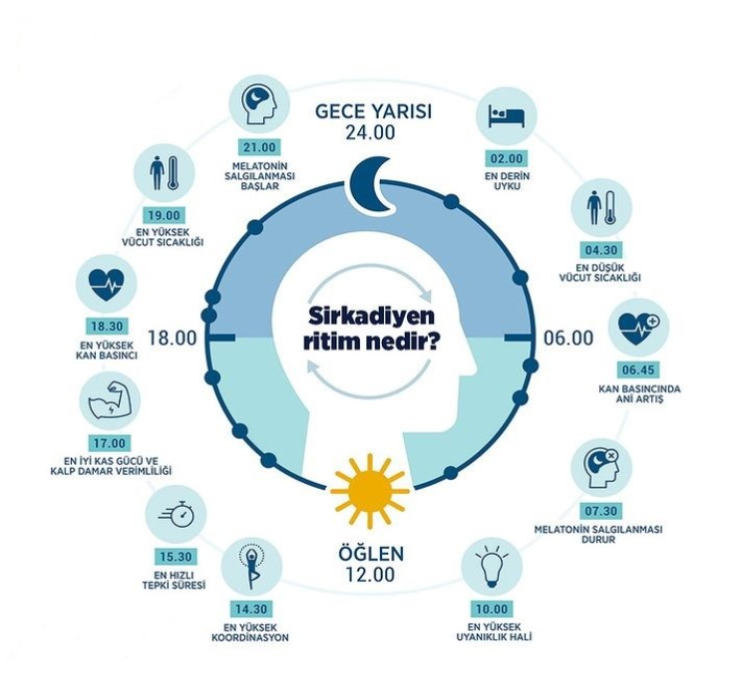
The circadian rhythm is the natural sleep-wake cycle that repeats every 24 hours a day. Disruption of this cycle is circadian rhythm sleep disorder. Circadian rhythm disorder can cause symptoms ranging from daytime sleepiness to depression. Circadian rhythm is influenced by environmental factors such as light and dark, meal timing or physical activity. Your brain receives signals from your environment and activates certain hormones. It changes your body temperature and regulates your metabolism to keep you awake or falling asleep. Circadian rhythm disturbances may occur due to external factors or sleep disorders.
How does the Circadian Rhythm affect your health?
Maintaining your circadian rhythm is very important for your health. If you experience a disruption in your circadian rhythm or have trouble getting the proper amount of sleep, you may experience both short-term and long-term effects on your health. Disruption of your circadian rhythm can cause health problems in various parts of the body (organs, cardiovascular system, metabolism, gastrointestinal system and skin) in the long run. It may also pose a risk for obesity and mental health conditions.
Brief interruptions to your circadian rhythm can result in:
• Memory problems
• Lack of Energy
• Delayed healing of wounds
• Problems with digestion and intestines
• Changes in your body temperature
A Series of Insomnia Cases Are Caused by Autonomic Nervous System Disorders
Scientific data
Several studies have shown an association between activation of the sympathetic nervous system and difficulty falling asleep.
Chronic insomnia is associated with nictohemeral activation of the hypothalamic-pituitary-adrenal axis (2001) – This study, conducted at the University of Pennsylvania, reveals the role of ANS (autonomic nervous system) instability in creating insomnia. It has a more important role than circadian rhythm disorders. “These findings are consistent with a central nervous system hyperarousal disorder rather than a sleep loss, which is usually associated with any change or decrease in cortisol secretion or a circadian disturbance.
Sleep onset and cardiovascular activity in primary insomnia (2011) — This study testing the sleep patterns of 8 insomnia patients and 8 normal sleepers, ‘normal sleepers follow the expected progressive autonomic decline, whereas insomnia patients show sustained sympathetic hyperactivation. «These data show that stable sympathetic hyperactivation is detected in insomnia patients, while normal sleepers follow the expected progressive autonomic decline»
Hyperarousal and insomnia (1997) — Another study shows that “good” sleepers who are exposed to stimulation of the sympathetic nervous system for a week have the same difficulties as those who suffer from insomnia.
Other studies supporting this hypothesis include: Hyperexcited model of insomnia: review of concept and evidence (2010), Human physiological models of insomnia (2007), Autonomic Activation in Insomnia: The Case of Acupuncture (2011).
Autonomic Nervous System? What kind of mechanism are we talking about?
In general, we can say that the nervous system is a suprabody system. Here, our autonomic nervous system controls all vital functions in our body. This system is active day and night continuously and controls functions such as involuntary heartbeat, digestion, respiration, blood pressure or urinary bladder function. Functions such as sweating or acceleration of the pulse that occur in the case of bodily strain are also processes directed by the autonomic nervous system.
The autonomic nervous system consists of two parts, the sympathetic nervous system (sympathetic) and the parasympathetic nervous system (parasympathetic), which affect the organs in opposite ways. The sympathetic nervous system stimulates energy expenditure in case of increased activity of the body or in situations of stress, for example, it accelerates heart rate and breathing and raises blood pressure.
On the other hand, the parasympathetic nervous system controls the process of energy storage and restructuring during quiescence and rest, for example, the heart rate decreases, the stimulation of the glands and the movement of the digestive system muscles slow down.
Are There Periods of Sleep?
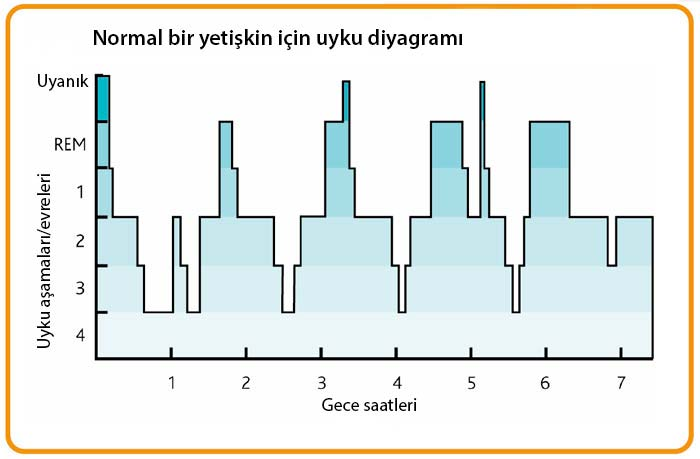
There are 5 different periods in sleep. One of these periods is called REM (Rapid Eye Movement), which is characterized by rapid eye movements, and the others are called non-REM periods or Non-REM. The non-REM period can be divided into two main parts:
Superficial sleep (1st period and partially 2nd period) Deep sleep (3rd and 4th periods). If a definition is made to include these periods, it can be said that sleep is the periodic transitions between wakefulness and 5 sleep periods. Usually, after a short awake period, people enter periods 1, 2, 3 and 4. The first REM period occurs approximately 90-120 minutes after the onset of sleep. Afterwards, 3-5 REM periods are passed in a night with 90-120 minute intervals. Approximately 5-10% of young adult sleep is in the 1st period, 45-60% in the 2nd period, 20-25% in the 3rd and 4th periods, and 20-30% in the REM period. Generally, non-REM sleep takes place in the first third of sleep, and REM sleep takes place more in the last third. Superficial sleep constitutes the period between the sleep-wake transition, and people can be awakened easily during this period. During deep sleep, a more intense stimulus is needed to awaken the person. It is accepted that the changes in this period serve to rest and renew the body. In cases where deep sleep is not adequately asleep or experimentally eliminated, people cannot rest; They complain that they wake up tired in the morning and that they are not in a position to carry the burden of a new day.
Psychology and Sleep
Sleep problems and sleep complaints are seen in almost every psychological and psychiatric disorder. In these processes, changes are observed in the quality and quantity of sleep. Sleep is a very complex function and is necessary for the healthy functioning of the body. Sleep is very important in memory, learning and mood regulation. Sleep problems reduce the quality of life of people and delay the treatment response in mental problems.
Since the course of the diseases affects the effectiveness of the treatment and the quality of life, sleep problems in mental disorders must be taken into account and the patient’s sleep habits, sleep structure and disorders must be learned. As you can see, sleep plays an important role in many diseases. Sleep patterns are very important for treatments to be effective, and sleep disorders are seen in many psychological disorders and cause many diseases. That’s why everyone who has sleep disorders should receive therapy.
Some people (mostly those who are overly stressed and therefore suffer from sleep problems) create their own insomnia because they are afraid of not being able to fall asleep. They fear the effect that lack of sleep will have on them the next morning (for an exam or interview, for example), creating what’s known as performance anxiety. This anxiety is an obstacle to sleep.
In the context of insomnia, paradoxical intent is about passively trying to stay awake without actively trying to fall asleep. With Zen Uyku, the user lies on their back keeping their eyes open while synchronizing their breathing with the light signal on the device according to the heart rate data from the wristband. Thus, performance anxiety disappears and sleep becomes easier.
Why Was This Special Light Chosen?
It may worry you that some studies and scientists have a bad idea about blue-violet light, but the special light of Zen Uyku does not disturb your circadian rhythm.
The blue-violet light of a special frequency, which it receives from the wristband and reflects it on the ceiling with a special rhythm, has a very low intensity (for someone in a sleeping position) compared to the high-intensity (60 lux for 50 cm distance) blue light from a TV or computer screen that you are exposed to during the normal day. less than 1 lux). Moreover, your exposure to the blue-violet light of Zen Uyku is minimal. (8-20 min)
Zen Uyku has almost zero impact on the Circadian rhythm, so you don’t have to worry about delaying your sleep or offsetting the positive effects described above. The halo of light is actually more color than light. The light of this special frequency, obtained as a result of research in sleep laboratories, has no harm. As a result of many trials, we have used the most accurate light frequency for you in our product.
Scientists at the University of Granada and the San Rafael Granada Special Education Center have shown that blue light has a very positive effect on people who feel acute psycho-social stress.
So is there a component that makes good sleep possible and is it possible to sleep better and feel better using it?
Melatonin
Indeed, there is such a hormone, and its name is melatonin. This hormone secreted in the pineal gland in the brain regulates the sleep-wake cycle. When the hour when our body is used to sleep approaches and the light intensity around us begins to decrease, melatonin secretion increases and the body prepares for sleep. When our body is close to completing its sleep cycle and the light intensity in the environment increases, melatonin secretion decreases and serotonin synthesis, which provides the connection between nerve cells and gives us a feeling of vitality, increases. In other words, thanks to the hormone melatonin, we get a good sleep and benefit from the benefits of sleep. We don’t have to worry about where to get the melatonin. It is naturally synthesized by our body during sleep.
Thanks to the relaxing blue light that Zen Uyku reflects to the ceiling, special to your heart rate, thanks to its wristband, it helps to secrete melatonin when you have difficulty falling asleep, offering you a comfortable and quality sleep.
Why Are Breath Therapy and Sleep So Connected?
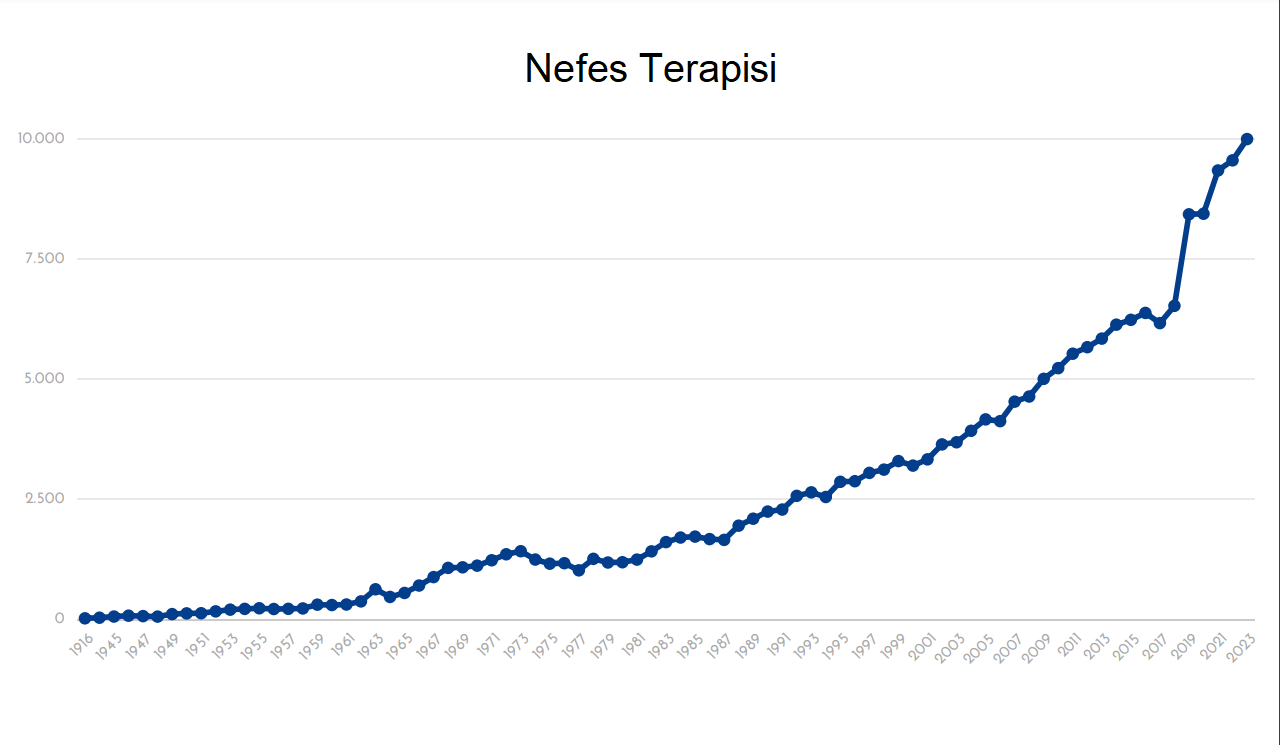
(Breathing therapy search results Source: Pubmed)
As a result of our research, we decided to keep the exhalation longer than the inhale. A longer exhalation results in a greater feeling of fatigue.
A sleep doctor we encountered during our research explained this phenomenon to us. When exhalation (breathing out) is longer than inhaling (breathing), more CO2 is released. When the concentration of CO2 in the blood decreases, the size of the cerebral vessels also decreases. This phenomenon, called vasoconstriction, causes a feeling of fatigue.
This effect is especially beneficial for a person with a mild circadian disorder (watching TV, lying down for a few hours) and still not feeling tired. Melatonin is normally responsible for the fatigue effect. One reason for these conditions may be that the body does not produce enough melatonin. The effect of a long exhale can act as an effective substitute.
Controlled deep breathing has long been one of the traditional Eastern healing methods. Method; In the 70’s Dr. With Herbert Benson’s best-selling book The Relaxation Response, he headed west, and it was observed that the method reduces stress both scientifically and in chemical-free ways.
Solution
Thanks to its special structure, Zen Uyku helps you get rid of the main obstacles to a quality and comfortable sleep. It is easy to use and install, harmless, not addictive, aesthetic, nature friendly, economical. Our aim is to reach people who have sleep problems by creating a product that is comfortable to use and suitable for the budget referenced by physicians.